
The Board of Aldermen held a hearing to discuss this idea on July 9, 2024: https://youtu.be/TF_sWQK3FBQ?feature=shared
Traffic Calming and Pedestrian-Friendly Street Design
From "Vote on Priority Ideas"
Go to the project
Priority: Improving Community Mobility & Increase Public Safety
Author/Sources: Andrew Gaus, Liz Kramer, Michael T, Julie Padberg-White, Kevin Hink, Jason Lammert, Malik Lendell
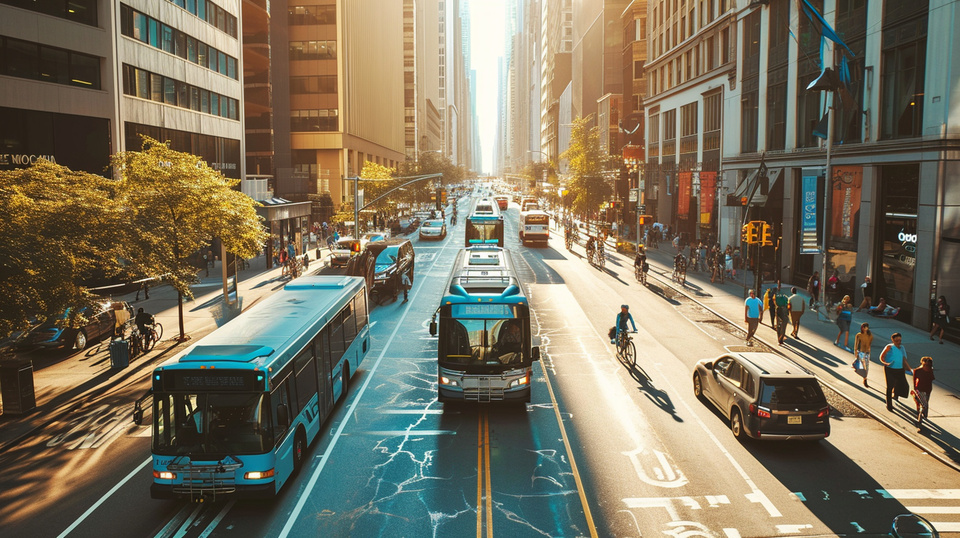
Unsafe road design that fail to discourage reckless driving and speeding make it difficult, unpleasant, and dangerous for people to move around the city, in particular as pedestrians. By redesigning our streets to slow down drivers, the City could not only protect pedestrians and bicyclists, but also improve quality of life for all residents. Traffic-calming design elements include better lighting, narrower lanes, pedestrian-only areas, wider sidewalks, crosswalks, curb bump-outs, reflective painting, and street trees to shade sidewalks. The City could establish a dedicated team within the Streets Department to pilot street redesign.
This idea could be partially funded by the annual interest accrued by a municipal endowment fund, and could potentially be supplemented by other City funding, state and federal grants.
Funding Considerations
- Cost estimate: To be assessed
- Can this be funded from interest via a Municipal Endowment Fund? (Estimated value of $12M annually): Yes
- Does this require matching funds? (More than $250M) No
- Is this eligible for a tax-exempt bond? (Project benefits taxpayers and proceeds used by governmental entity) Yes
- Is this likely to attract philanthropic funding? Uncertain
- Are there other potential funding sources? Yes
City: General Revenue, Ward Capital, ARPA
State: Traffic Engineering Assistance Program (TEAP); Transportation Alternatives Program (TAP); Community Development Block Grants (CDBG)
Federal: Safe Streets for All (SS4A)
Official updates
Last update: July 10, 2024
Posted on July 10, 2024
Comments(59)
Please to comment.
Most recent comments have loaded.
Profile of Paula Kyla Oudshoorn
Posted by:Paula Kyla Oudshoorn
2 years ago
First focus on simply paving the streets and fixing potholes. Rough, damaged roads are a hazard to everyone, and please use reflective paint for lines and add signage. So many streets don't even have a snow route sign or a one-way sign. Just do the basics first!
Profile of Martha Navarro
Posted by:Martha Navarro
2 years ago
@Paula Kyla Oudshoorn
This is a must and I agree... there needs to be reflective paint used! It is so hard to see the lines - especially at night and in the rain.
Fixing pot holes and repaving is a must as well - but there needs to be communication between the Street Department and Utilities so that once the repaving has happened, the Utilities do not come and dig up the streets that were just paved... I've seen this happen so many times over the years.
Profile of Sharon Shamin

Posted by:Sharon Shamin
2 years ago
The traffic is so dangerous. Too many speeding vehicles, running of stop lights, car break ins & thefts.
Profile of Glenn Eckert
Posted by:Glenn Eckert
2 years ago
@Sharon Shamin … and how many arrests are being made? Police are on the streets to protect the citizens. Again, how many arrests are being made?
Profile of Martha Navarro
Posted by:Martha Navarro
2 years ago
@Glenn Eckert
They need to put more of the speed humps on the major streets to slow down traffic - like the ones they put on side streets. I'm not a big fan of them, but unless the person wants to mess up their car, they will slow down. And I'm not sure how to even get people to stop using the change lanes as a driving lane, much less people follow basic traffic laws again.
Profile of Mitchell Easter
Posted by:Mitchell Easter
2 years ago
The roads are not unsafe in design. They were designed with over double perhaps triple the population in mind. Big difference is the means of how transportation was when the roads were laid out at the time. The problem is even more basic than we think: traffic lights are improperly calibrated and thus flow is dysfunctional with respect to current traffic patterns; too many drivers are careless and have absolutely no reason to be behind a wheel, period; incongruous bike lanes ending at the margins of the ward; third world country style disrepair of main thoroughfares with more craters than the moon; and poor legislation/lack of enforcement.
Does it really need to be such, that at 12:04 am at the intersection of Fyler and Kingshighway, when no cars are coming onto KGHWY from Fyler that that light remains red at NB and SB at KGHWY for as long as it does? Traffic Department, what excuse is there as why you cannot change the timing on the traffic lights? Lack of employees? Pay too low? Are we even aware? Do we care? Perhaps it’s the citizens who don’t complain enough. Anyway, case in point: many of the lights need to be changed from timers to sensors. Easy. And no, a study is not needed to reveal information we all already know.
Also, this type of projects funding should already be in a comprehensive budget plan for the city, not some funny-money pot of gold from the Rams.
How about updated traffic and street signs, calibrated traffic lights, reduction in number of lanes, and aggressive enforcement?
Profile of Robert Dowgwillo
Posted by:Robert Dowgwillo
2 years ago
@Mitchell Easter Whatever we do, it should be done in steps. Make a change...assess the effect...make the next change. NOT throw money at some huge infrastructure project that will take years before we see a benefit. Pick the low hanging fruit first. I agree with you your call for signage, traffic light timing etc. But NOT moving dirt and pouring concrete. And, heaven forbid, we truly enforce the traffic laws. Every now and then the news reports a traffic enforcement crackdown, like 100 tickets issued in 10 hours. That is window dressing. We need consistent enforcement, fines, penalties, imprisonment and auto impoundment as necessary, We have license plate reader cameras...USE THEM...that is assuming the cars actually HAVE a plate. No excuses for the situation we are in.
Profile of Glenn Eckert
Posted by:Glenn Eckert
2 years ago
Police are needed more than traffic calming.
Profile of Judith Broleman
Posted by:Judith Broleman
2 years ago
Support more police
Profile of Gary Stevenson
Posted by:Gary Stevenson
2 years ago
This money should go to cracking down on drivers driving without licenses, registration, and insurance.
If you make it where those drivers are not on the road, you will see a DRASTIC decrease in traffic accidents and even crime.
Profile of Deborah Hopkins
Posted by:Deborah Hopkins
2 years ago
I totally agree with you on this idea.
Profile of Eric Bulthuis
Posted by:Eric Bulthuis
2 years ago
This is the worst idea to make it through the preliminary rounds of vetting in my opinion.
1. How are we going to completely redesign our road and sidewalk network when we can't even effectively maintain the one we have?
2. The solutions that would be most effective in countering reckless driving such as better synchronized and sensored traffic lights and enforcing traffic laws and automobile registrations aren't mentioned in the description of the proposal.
3. One of St. Louis's biggest problems is that less and less people want to come into the city to do business, shop, or otherwise recreate. And one of the biggest reasons for this is because it's a pain to get around. Public transport is pretty limited and people don't trust the Metrolink and MetroBus from a safety and cleanliness standpoint. The vast majority of people who do come into the city prefer to do so by car and if you make it harder to bring a car into the city don't be surprised to see St. Louis get even emptier.
4. There are many other issues that should be higher on the list for funding. Again, having streets and sidewalks that aren't in a constant state of disrepair would be nice. St. Louis already has adequate sidewalk coverage. I think more people are concerned about getting shot, mugged, or harassed while walking around the city than the traffic.
Profile of Ronald Wagoner

Posted by:Ronald Wagoner
2 years ago
@Eric Bulthuis Kind of ironic when you write about safety concerns regarding public transportation, for, although I haven't seen any statistics in support, but it seems to me that driving an automobile is FAR more dangerous than taking a bus or train. In fact, when I consider the number of trips in my life using public transportation and either riding or driving in an automobile, I've had more life threatening events in the automobile than I've had using public transportation. I'm afraid that you're just overreacting to the fear mongering perpetrated against the public by the fossil fuel industries in an effort to preserve their profits at the expense of people and the environments. And the only problems I've experienced while walking have been because of idiots in automobiles running red lights either while I'm in the crosswalk or beginning into the crosswalk.
Profile of Eric Bulthuis
Posted by:Eric Bulthuis
2 years ago
@Ronald Wagoner Well to begin with, I'm not even necessarily making the claim that driving is safer than public transportation per se. I'm just pointing out that the perception regarding St. Louis public transit to the broader public is that it is inefficient, less safe and less desirable than simply using their own vehicle to get around. I would personally be very happy if that reputation was reversed.
As for statistics, according to Trailnet, an STL organization that promotes pedestrian and bike friendly urban planning, there were 8 total pedestrian fatalities and 274 people were injured biking or walking in the City in 2023. So, I agree that’s a real problem that should be fixed. However, SLMPD reports 158 homicides 550 shootings, 744 robberies 82 rapes, and 3,054 aggravated assaults in 2023. So, when I walk around the city of St. Louis and I think about safety guess which set of statistics I care about more? And guess which set of statistics I feel warrants more attention and more resource allocation?
Profile of Robert Dowgwillo
Posted by:Robert Dowgwillo
2 years ago
@Eric Bulthuis I agree with your position. Writer Stephen Eide has observed that a "classic pathology" of liberal policy making is taking on new commitments before making good on existing commitments. Before we spend millions on tearing up and redoing our existing road network (with no guarantee of outcome) we should "make good on existing commitments" and enforce the traffic laws long and hard enough to reverse the current trend and get some semblance of order AND get the most reckless and dangerous people off the streets.
Profile of Paula Kyla Oudshoorn
Posted by:Paula Kyla Oudshoorn
2 years ago
@Eric Bulthuis I agree with all of your points. Bike stats show that approx .05 % commute by bike, leaving the vast majority traveling by car or metro.
Profile of Robert Dowgwillo
Posted by:Robert Dowgwillo
2 years ago
Before we spend ANY money on expensive infrastructure for "traffic calming and pedestrian-friendly street design", we should embark on a serious campaign to enforce our traffic laws, including auto registration. I am sure we would be told this would require more police resources. Fine, then let's put some money to it. It is most likely that a relatively few number of drivers are responsible for the vast majority of the recklessness and endangerment this idea proposes to address. First, get those miscreants off the road, send the message we are serious about traffic safety, THEN see what infrastructure improvements are needed.
Profile of Ronald Wagoner
Posted by:Ronald Wagoner
2 years ago
@Robert Dowgwillo I think you should do your homework. Here's a hint: traffic calming is designing streets so idiots in their cars (I know it's a tautology) aren't likely to misuse the streets.
Profile of Adrian Martin
Posted by:Adrian Martin
2 years ago
@Robert Dowgwillo the supply of idiots is never ending. You get some off the streets, many more will take their place. You can only control the constants, not the variables. And what you can control is making the streets safer. You can maybe invest in some education too, but how much and how fast can you get to the roots of ignorance and stupidity?
Profile of Robert Dowgwillo
Posted by:Robert Dowgwillo
2 years ago
@Ronald Wagoner Infrastructure solutions like traffic calming are always attractive because someone can see something happening and feel better about it regardless of whether the desired effect is ever achieved. The answer is, too often, just more of the same.
Streets that are obviously dangerous due to surface condition, poor signage and striping etc. should be part of any solution, But, Ignoring what motivates people to do what they do is simply poor policy. Lack of enforcement is a motivation to ignore the law. Enforcement simply must be part of the effort to make our streets safer. Not as sexy as planters and bump outs, but necessary.
Profile of Gary Stevenson
Posted by:Gary Stevenson
2 years ago
@Ronald Wagoner When you have someone in a stolen car or expired temp tags, they will still find a way to drive insane. We need to get the dangerous, unlicensed, and uninsured drivers out of the ball game to really start focusing on the normal drivers. That starts with enforcement not traffic calming.
Profile of Jonathan Ferry

Posted by:Jonathan Ferry
2 years ago
Traffic calming and pedestrian-friendly street design is a terrific idea. However, it is one that can be pursued incrementally through a combination of changes to zoning codes and street redesigns coordinated with redevelopment projects, funded by tax increments from those projects.
The city could eat up this entire fund just trying to improve Gravois and Tucker, which are probably two of the least pedestrian friendly roads you will find anywhere. But then what? That is only two roads out of hundreds if not thousands in the city, and it won't spur enough long-term change to get the city out of the hole in which it currently resides.
Share
Posted by
Profile of Board of AldermenBoard of Aldermen on January 4, 2024

Current status
under consideration